Thursday, October 16, 2014

Chapter 20 Study Guide


The Baroque in Northern Europe

Baroque Flanders
  • Peter Paul Rubens, Arrival of Marie de’ Medici at Marseilles, 1622-1625
  • Peter Paul Rubens, Consequences of War, 1638-1639
Baroque Netherlands
  • Frans Hals, Archers of Saint Hadrian, c. 1633
  • Judith Leyster, Self-Portrait, c. 1630
  • Rembrandt van Rijn, Night Watch, 1642
  • Rembrandt van Rijn, Return of the Prodigal Son, c. 1665
  • Jan Vermeer, Woman Holding a Balance, c. 1664
Baroque France
  • Nicolas Poussin, Landscape with Saint John on Patmos, 1640
  • Claude Lorrain, Landscape with Cattle and Peasants, 1629
Baroque England
  • Sir Christopher Wren, Saint Paul’s Cathedral, 1675-1710

1. How did Rubens accomplish such an enormous number of large scale paintings in his lifetime?
2. Why are religious subjects less prevalent in Dutch Baroque paintings than in the paintings of the same period from Italy, Spain, and Flanders?
3. How did patronage and collection of art in the Dutch Republic differ from that of Spain and France?
4. What do the skull, timepiece, and overturned glass symbolise in Vanitas Still Life by Pieter Claesz?
5. Explain the difference between etching and engraving.
6. What does the vast complex at Versailles symbolize?

Chapter 19 Study Guide


The Baroque in Italy and Spain

Baroque Italy
  • Carlo Maderno, facade of Saint Peter’s, 1606-1612
  • Gianlorenzo Bernini, David, 1623
  • Gianlorenzo Bernini, Ecstasy of Saint Teresa, 1645-1652
  • Francesco Borromini, San Carlo alle Quattro Fontane (view into dome), 1638-1641
  • Caravaggio, Calling of Saint Matthew, c. 1597-1601
  • Artemisia Gentileschi, Judith Slaying Holofernes, c. 1614-1620
Baroque Spain
  • José de Ribera, Martyrdom of Saint Philip, c. 1639
  • Diego Velazquez, Las Meninas (The Maids of Honor), 1656

1. Name three things that characterize the Baroque style in Italy and Spain.
2. What do the two colonnades that Bernini designed for Saint Peter’s Piazza symbolise?
3. Bernini’s baldacchino serves as marker over which important religious site?
4. The Baroque style in Catholic countries was generally associated with which religious movement?
5. What is unusual about Annibale Carracci’s artistic training compared to the artistic training of painters we have previously examined?
6. Define tenebrism.

Thursday, October 9, 2014

Group Assignment (10/16)


As a group, analyze the work of art you have been assigned. Attempt to identify the artist, subject, culture, and approximate time period of the work using visual evidence and your own knowledge of history and art. Do not simply list off facts you have found through Google. Support any conclusions you come to with specific details from the work. Discuss anything you may find interesting in the piece such as potential symbols, connections with other works, or artistic virtuosity.

Group 1:


Group 2: 


Group 3: 


Group 4: 


Group 5: 


Tuesday, October 7, 2014

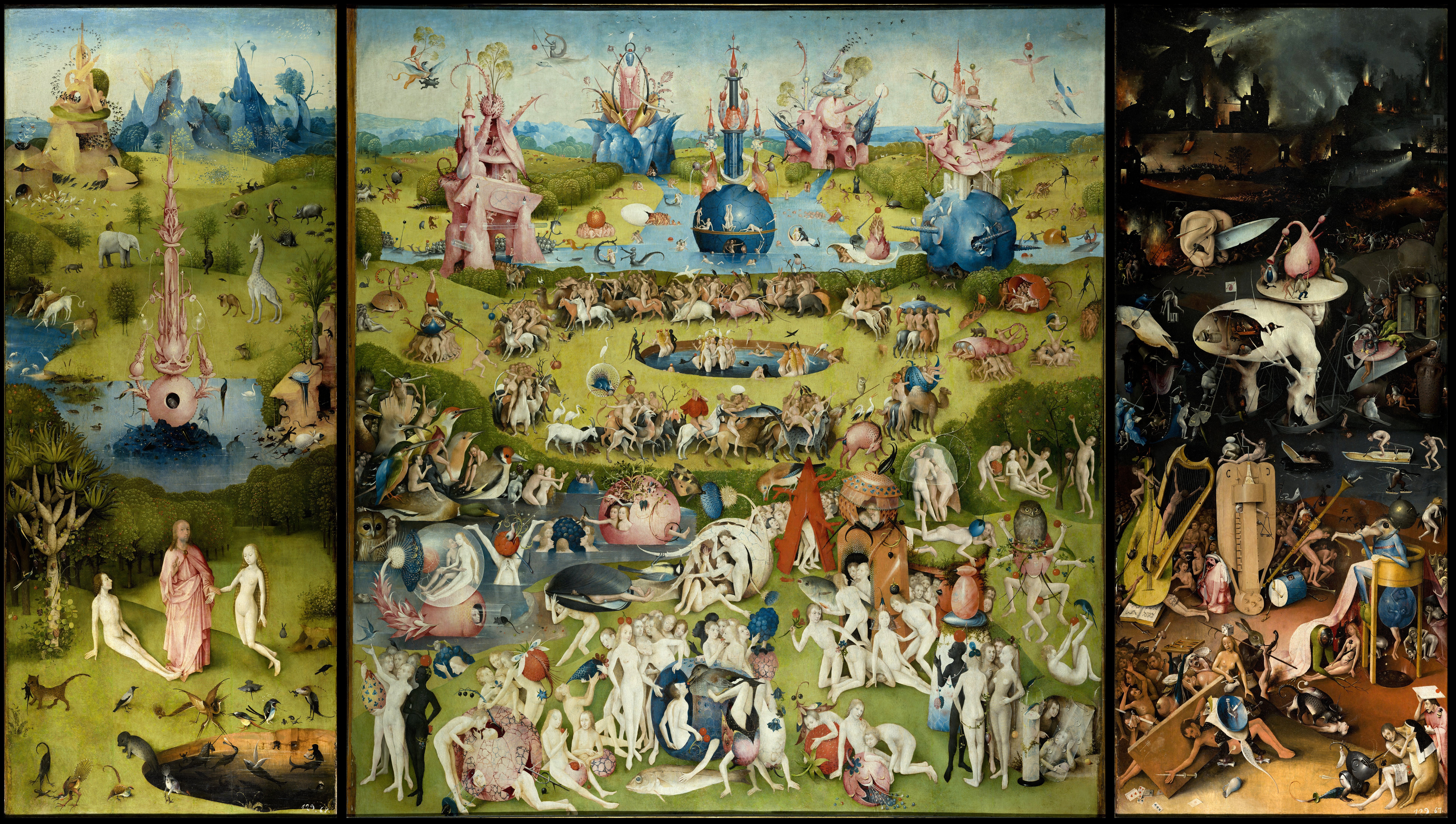
Garden of Earthly Delights

High Res Image

Chapter 18 Study Guide


High Renaissance and Mannerism in Northern Europe and Spain

Northern Renaissance
  • Grunewald, Isenheim Altarpiece, c. 1510-1515
  • Bosch, Garden of Earthly Delights, 1505-1510
  • Durer, Melencolia I, 1514
  • Durer, Self-Portrait, 1500
  • Cranach the Elder, Judgment of Paris, 1530
  • Holbein, The French Ambassadors, 1533
  • Bruegel, Hunters in the Snow, 1565
  • El Greco, Burial of Count Orgaz, 1586

1. What detail in Grunewald’s Isenheim Altarpiece acknowledges the patients at the hospital for the which the work was commissioned?
2. Who was the first non-Italian artist to achieve international fame? What artistic medium allowed for the widespread distribution of his work?
3. Who was Martin Luther and what was the Protestant Reformation?
4. How does Durer show his support for Lutheranism (Protestantism) in his painting Four Apostles?
5. What optical illusion appears in Holbein’s The French Ambassadors?
6. What is a genre scene?

Thursday, October 2, 2014

Essay Titles/Questions


Choose ONE of the questions below and answer it in an essay that is between 2 and 3 pages long. Use specific examples of works of art and architecture which we have looked at in class and that are relevant to your argument. (Typed, MLA Format)

  1. The Evolution of the Donor Portrait: Track the evolution of donor portraits (portraits of the work’s patron[s]) within religious works of art from the late Medieval through Renaissance periods. Choose 3-5 works that include donor portraits which we have examined in class and discuss how the portrayal of the donor[s] reflects the attitudes, preoccupations, beliefs, etc. of the culture in which each piece was made. Consider placement, size, and prominence of the donors when discussing each work.
  2. The Renaissance Nude: The nude human form, which had become exceedingly rare in the Middle Ages, made its return in Italy during the Renaissance. Using 3-5 examples from the course, discuss the development of the nude figure from its return to prominence in the Quattrocento through the Cinquecento. Analyze how the reemergence of the male nude is reflective of the cultural environment and shifting attitudes in Italy during this time period. Consider the changes in form and association the nude figure underwent over the course of the time period. Keep historical context in mind.
  3. Classicism in Renaissance Architecture: How did classicism (elements of classical Greece and Rome) influence the architecture of the Italian Renaissance (Early, High and/or Venetian), and to what extent did Renaissance architects deviate from their classical predecessors? Use 3-5 examples of Renaissance architecture to support your argument.


(40 points)
Due: Thursday 9 October

Thursday, September 18, 2014

Group Assignment (9/25)

Compare and Contrast

Identify artist, title, and culture/style of each image and analyse their similarities and differences in style, symbolic meaning, function, and how they are representative of their respective cultures.

1. 

A. 

B. 


2. 

A. 

B. 

3. 

A. 

B. 

4. 

A. 


5. 

A. 

B.